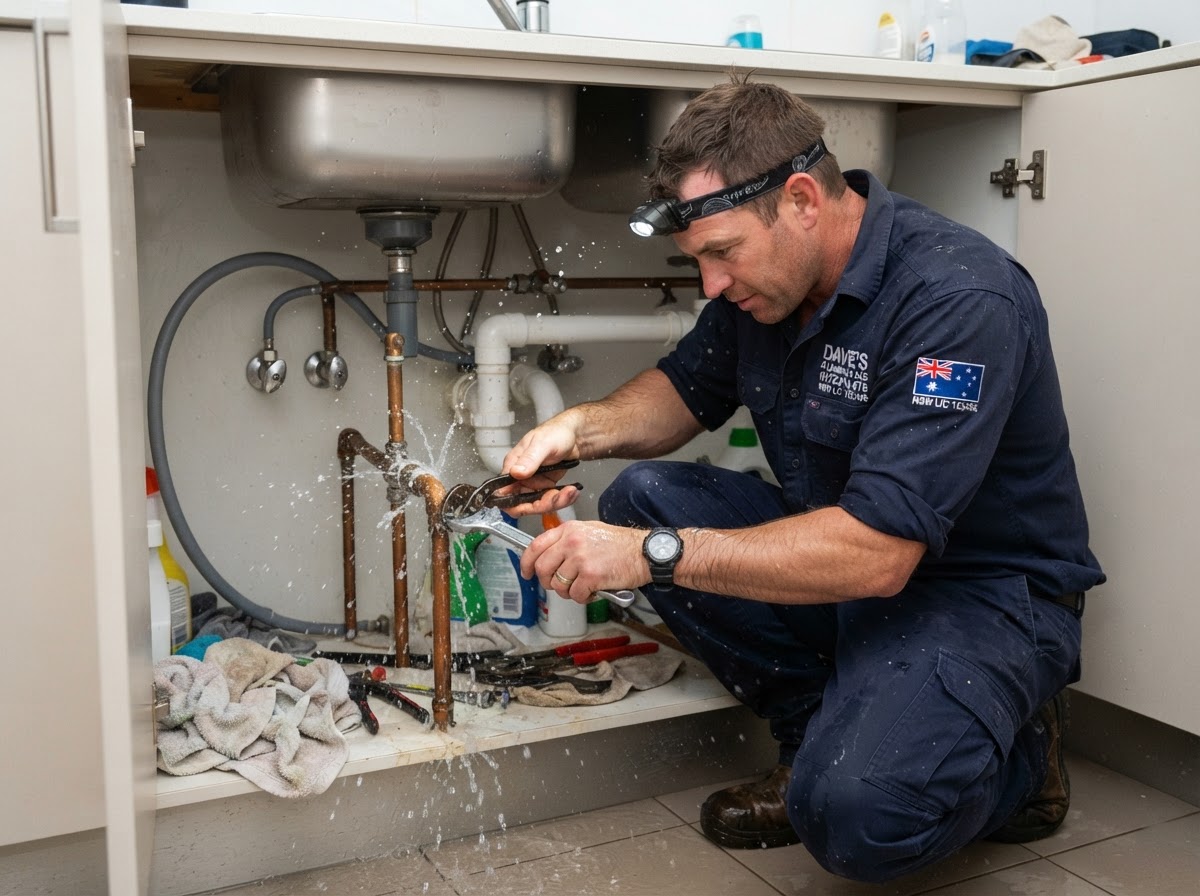
A burst water pipe can release hundreds of litres in a matter of minutes. Water spreads fast, and it doesn't take long for it to reach flooring, walls, cabinetry, electrical fittings and furniture. What you do in the first few minutes after discovering a burst pipe can make a significant difference to the amount of damage your property sustains.
This guide walks through the immediate steps to take when a pipe bursts in your Gold Coast home or business, where to find your water shut-off valve, how to tell whether the situation is an emergency, and what to expect when a plumber arrives. If you're dealing with a burst pipe right now, call 1300 000 000 and we'll guide you over the phone while a plumber is on the way.
What to Do If a Pipe Bursts
Work through these steps in order. Your safety comes first — if water has reached electrical areas or you're unsure, skip to step 2 and call for help.
- Turn off the water supply at the nearest isolation point or the main shut-off valve.
- Turn off electricity at the switchboard if water is near power points, appliances or wiring — and only if it's safe to do so.
- Move furniture, electronics and valuables away from the water if it's safe to enter the area.
- Place towels, buckets or containers to contain the spread of water.
- Stop using all water in the property until the plumber arrives.
- Call a licensed plumber immediately on 1300 000 000.
Step 1: Turn Off the Water
The first priority is to stop the water flowing. The faster you can isolate the supply, the less water enters your property. There are generally two levels of isolation: a local isolation valve near the fixture (such as a tap under a sink), and the property's main water shut-off valve. If the burst pipe is after a local valve — for example, under a kitchen sink — turning that valve may be enough. If the leak is larger or you can't find a local valve, go straight to the main shut-off.
The Queensland Government advises householders to turn off the mains water supply for burst pipes or major leaks. If you're renting or living in a unit and can't locate the isolation point, contact your property manager or building management immediately — they may need to shut off water to the building or your unit from a shared service area.
Don't force a valve that's stiff or seized. If the valve won't turn, call a plumber immediately — we can talk you through alternatives while en route.
Turn Off Electricity If Water Is Near Electrical Outlets
Water and electricity are a dangerous combination. If water has reached or is flowing towards power points, electrical appliances, switchboards, ceiling lights or any electrical equipment, you need to isolate the power — but only if you can do so safely.
If your switchboard is in a dry area and you can reach it without walking through water, switch off the relevant circuits or the main switch. If the switchboard is in or near the flooded area, do not attempt to reach it. Do not touch electrical fittings, switches or appliances while standing in water or on a wet surface. In that situation, leave the area and call your electricity provider and a licensed plumber immediately.
Move Furniture and Valuables Away From the Water
Once the water is isolated and you've addressed any electrical risk, take steps to protect your belongings — but only if it's safe to enter the affected area.
- Move furniture away from the water or lift it onto blocks if it can't be moved.
- Lift electronics, chargers and appliances off the floor.
- Remove rugs and mats that could soak up water.
- Move important documents, photos and valuables to a dry area.
- Place towels, mops or buckets along the leading edge of the water to slow its spread.
- Open windows and doors to improve ventilation if weather permits.
Personal safety always comes before property protection. Don't enter a room if water has reached electrical outlets, and don't risk injury trying to move heavy items through standing water.
Stop Using Water Until the Plumber Arrives
Even after you've isolated the main supply, avoid using any plumbing fixtures until the burst pipe has been assessed and repaired. Running a tap, flushing a toilet or starting a washing machine could introduce more water into the system, increase the leak or cause additional damage to already compromised pipework. If the isolation valve didn't fully stop the flow, using water elsewhere in the property may worsen the problem.
Where Is the Main Water Shut-Off Valve?
Knowing where your main water shut-off valve is before a plumbing emergency happens is one of the most useful things a property owner can do. The location varies depending on the type of property.
Houses
In a typical Gold Coast house, the main shut-off valve is usually found in one of these locations:
- Near the front hose tap — often on the same pipe, just before the tap.
- Next to the water meter, which is usually near the property boundary or front fence.
- Inside a meter box or chamber at the front of the property.
- In some older homes, inside a cupboard or laundry near where the main pipe enters the building.
The valve is typically a lever or tap handle. Turn it clockwise to close it. If it hasn't been used in years, it may be stiff — don't force it to the point of breaking it.
Units & Apartments
Water isolation in apartments and unit blocks is more complex. The shut-off point may be:
- An individual unit isolation valve, sometimes in a service cupboard, laundry or bathroom.
- A shared meter area on the ground floor or in a basement car park.
- A building plant or service room that requires building management access.
If you live in a unit and can't find your isolation valve, contact your building manager, body corporate or property manager. In a burst pipe emergency, building management can often shut off water to your unit or the building faster than you can locate an unfamiliar valve. Don't assume every apartment building uses the same arrangement — the isolation setup depends on the building's age, design and plumbing configuration.
How Serious Is a Burst Pipe?
Not every leak is an emergency, but it's important to understand the difference so you know how quickly to act.
Minor Leak
A small, visible leak — such as a slow drip from a pipe joint under a sink, a weeping fitting or a pinhole leak — can often be contained with a bucket and may not require an emergency callout. However, even small leaks can cause damage over time and should be repaired promptly to prevent worsening.
Major Leak
A major leak is a plumbing emergency. Signs include:
- Water spraying or gushing from a pipe.
- A room flooding rapidly.
- Water coming through walls, ceilings or floors.
- A large volume of water escaping that you can't contain.
- Being unable to isolate the water supply.
Major leaks should be treated as emergencies. Turn off the water if possible and call a licensed plumber immediately on 1300 000 000.
Common Signs of a Burst or Hidden Water Pipe
Sometimes a pipe has burst or is leaking behind a wall or under a floor, and the problem isn't immediately obvious. Watch for these signs:
- A sudden drop in water pressure.
- Unexplained water pooling or damp patches.
- Wet patches on walls, ceilings or skirting boards.
- Water stains or discolouration appearing on paint or plaster.
- An unusually high water bill with no obvious explanation.
- The sound of running water when all taps and appliances are off.
- Mould growth or persistent dampness in a specific area.
- Water appearing under floors or lifting flooring materials.
Hidden leaks can cause significant structural damage before they're discovered. If you notice any of these signs, a plumber can use leak detection equipment — including thermal imaging and acoustic listening devices — to pinpoint the source with minimal disruption. See our leak detection services for more information.
What Causes Water Pipes to Burst?
Pipes burst for a range of reasons, and understanding the cause can help prevent recurrence:
- Ageing pipework — older pipes corrode or weaken over time, particularly galvanised steel and some early copper installations.
- Corrosion — internal or external corrosion can thin pipe walls until they fail.
- Damaged or worn fittings — joints and connections degrade and can separate or crack.
- Excessive water pressure — pressure that's too high for the pipe's rating stresses the system over time.
- Accidental damage — nails, screws or impact during renovations can puncture pipes.
- Deteriorated connections — flexible hoses, particularly those connected to sinks, toilets and washing machines, can fail.
- Ground movement — soil shifting, particularly in newer estates where ground is still settling, can stress underground pipes.
- Tree root intrusion — roots can crack and invade underground pipes, causing blockages and eventual failure.
On the Gold Coast, older properties in established suburbs like Southport and Burleigh Heads may have ageing pipework that's more prone to failure, while newer estates in areas like Coomera and Pimpama can experience issues as ground settles and infrastructure beds in. The type of pipework and the age of the property both influence the likelihood and nature of a burst pipe.
What Not to Do When a Pipe Bursts
In the rush to stop a leak, people sometimes make the situation worse. Avoid these common mistakes:
- Don't ignore the leak — even a small leak can worsen quickly and cause significant damage.
- Don't continue using water unnecessarily — it can increase the leak or cause further damage.
- Don't attempt complex plumbing repairs if you don't have the skills — you could worsen the damage or create a safety hazard.
- Don't enter areas where water may have contacted electrical systems.
- Don't remove walls or ceilings without professional assessment — you may not need to, and you could cause unnecessary damage.
- Don't assume the leak has stopped just because visible water has reduced — the problem may still be active behind a wall or under a floor.
- Don't delay calling a plumber if significant water damage has occurred — the longer water sits, the worse the damage.
What Happens When the Plumber Arrives?
When a licensed plumber attends a burst pipe, the process typically involves the following steps, though the exact approach depends on the pipe's location, material and the nature of the failure:
- Locate the source of the leak — which may require inspection or leak detection if the burst is hidden.
- Isolate the affected water supply if it hasn't already been done.
- Assess the damaged pipe or fitting to determine the cause and extent of the problem.
- Determine whether the pipe can be repaired or whether a section needs replacing.
- Remove and replace the damaged section of pipe or fitting.
- Test the repair by restoring water and checking for leaks.
- Check for additional leaks or weaknesses in the surrounding pipework.
- Advise on any further repairs or maintenance that may be needed to prevent recurrence.
The appropriate repair method depends on the pipe material, location and condition. A plumber won't know exactly what's needed until they've inspected the pipe — so it's not possible to guarantee a particular repair approach in advance.
Who Is Responsible for a Burst Water Pipe?
Responsibility for a burst pipe depends on where the damaged pipe is located and whether it's private property infrastructure or part of the water provider's network.
Generally, the property owner is responsible for plumbing within the property boundary — including pipes inside the home, under the house and up to the water meter. The water provider is responsible for the water main and the connection up to the meter. If the burst is on the provider's side of the meter, contact your water utility immediately.
For apartments and body corporate properties, responsibility can be more complex. It may depend on whether the pipe serves a single unit or is part of the building's shared plumbing infrastructure. Body corporate by-laws and the building's plumbing arrangements determine who's responsible for repairs. If you're unsure, check with your property manager, body corporate or the relevant water provider.
If you're a tenant, contact your landlord or property manager immediately — they're responsible for arranging plumbing repairs. You can still take immediate steps to isolate the water and minimise damage.
When Should You Call an Emergency Plumber?
A burst pipe is one of the most common reasons people call an emergency plumber. You should treat it as an emergency and call immediately if:
- Water is flowing rapidly and you can't contain it.
- You can't isolate the main water supply.
- The leak is causing significant property damage.
- Water is entering walls, ceilings or electrical areas.
- A pipe has completely failed and water is gushing.
- There's a major leak outside the property.
- The property is at risk of further water damage.
- The problem is affecting a business or commercial property and operations are disrupted.
Our emergency plumbers are available 24/7 across the Gold Coast for burst pipes, major leaks and other urgent plumbing problems. Call 1300 000 000 any time — we'll help you determine what to do while a plumber is on the way.
Need Help With a Burst Pipe?
If you've got a burst pipe, a major leak or any plumbing emergency on the Gold Coast, call us now on 1300 000 000 or request a plumber online. We're available 24/7 and will guide you through the immediate steps while a plumber is on the way.
Request a PlumberBurst Pipe Emergencies Across the Gold Coast
Burst pipes can occur in any type of property, and the response can differ depending on the building. Here's how the situation varies across common Gold Coast property types.
Burst Pipes in Gold Coast Homes
In houses and townhouses, the owner usually has direct access to the main water shut-off valve, which makes isolation faster. Common burst pipe locations include under sinks, in ceilings, behind walls and in underground pipes running to the street main. Older homes in established areas like Southport and Nerang may have ageing pipework that's more susceptible to failure.
Burst Pipes in Gold Coast Apartments
In apartments and high-rise buildings — common in Surfers Paradise, Broadbeach and Coolangatta — water isolation can be more complicated. A burst pipe in one unit can affect neighbouring units, particularly in vertical buildings where water travels downward. Building management or the body corporate may need to be involved to isolate the water. If you live in a unit, find out where your isolation valve is before an emergency happens.
Burst Pipes in Gold Coast Businesses
For commercial properties — restaurants, retail stores, offices and hospitality venues — a burst pipe can disrupt customers, damage stock and force closures. Fast response is critical to minimise downtime. Commercial properties often have more complex plumbing systems, including multiple isolation points and shared infrastructure, so it's important to have a plumber who understands commercial plumbing assess the situation.
We provide emergency plumbing services across the Gold Coast, from Southport and Broadbeach in the central corridor to Burleigh Heads and Coolangatta in the south, and Coomera and Pimpama in the north. Wherever you are on the Gold Coast, call 1300 000 000 for fast assistance.
Frequently Asked Questions: Burst Pipe Emergencies
What should I do first if a pipe bursts?
Turn off the water supply at the nearest isolation valve or the main shut-off valve. This is the single most important step — it stops the flow of water and limits damage. If you can't find the valve, call a plumber immediately and we'll guide you.
Where is the main water shut-off valve?
In houses, it's usually near the front hose tap, the water meter or the property boundary. In units and apartments, it may be an individual unit isolation valve, a shared meter area or a building service room. If you can't locate it, contact your building manager or property manager.
Should I turn off the electricity after a pipe bursts?
If water has reached or is flowing towards power points, appliances or the switchboard, isolate the power — but only if you can do so safely without entering a wet area. Never touch electrical fittings while standing in water. If the switchboard is in the flooded area, leave and call your electricity provider.
Is a burst pipe considered a plumbing emergency?
A major burst pipe — where water is gushing, flooding a room or entering walls and ceilings — is a plumbing emergency. A minor drip from a fitting may not be an emergency, but it should still be repaired promptly to prevent worsening. If in doubt, call and we'll help you assess the urgency.
How much does it cost to repair a burst pipe?
The cost depends on the pipe's location, the extent of the damage, the pipe material, whether the pipe can be repaired or needs replacing, and whether the callout is during standard or after-hours hours. We provide clear, upfront pricing before starting any work so you know what to expect.
How long does it take to repair a burst water pipe?
Repair time depends on the pipe's location and accessibility. A burst pipe under a sink with easy access may be repaired quickly, while a pipe behind a wall or under a floor may take longer to locate, expose and repair. We'll give you an indication of the expected time once we've assessed the situation.
Can a burst pipe be repaired or does it need replacing?
It depends on the nature of the damage. A localised crack or failed fitting can often be repaired by replacing the damaged section. If the pipe is extensively corroded or weakened, replacing a larger section may be the more reliable long-term solution. A plumber will advise after inspecting the pipe.
Who is responsible for a burst pipe on a property?
Generally, the property owner is responsible for pipes within the property boundary, while the water provider is responsible for infrastructure up to the water meter. In apartments, responsibility may depend on whether the pipe serves a single unit or is shared infrastructure — check with your body corporate or property manager if unsure.
Need a Plumber on the Gold Coast?
Call us or request a plumber online — we're here to help with any plumbing issue.
Request a Plumber